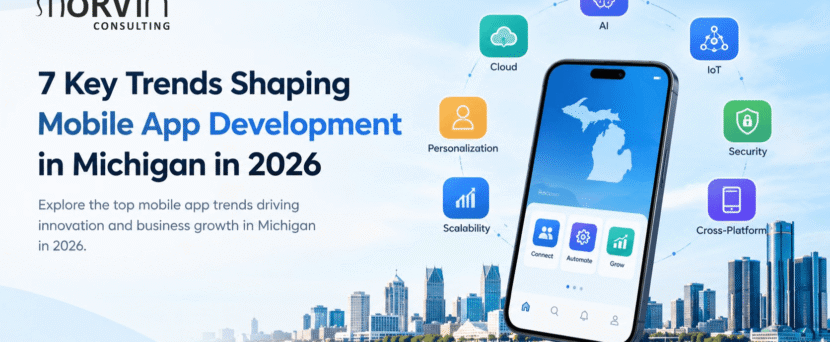
7 Key Trends Shaping Mobile App Development in Michigan in 2026
Michigan’s business landscape is becoming increasingly digital, with industries such as automotive, manufacturing, healthcare, logistics, and retail adopting mobile technology to improve efficiency and customer experiences. As businesses invest in digital transformation, mobile app development in Michigan is becoming essential for connecting with customers, automating operations, and supporting business growth.
In 2026, mobile applications are evolving through advancements in artificial intelligence (AI), connected devices, cross-platform technologies, and application security. Understanding these trends can help businesses make informed technology decisions and build applications that meet changing market demands.
AI-Powered Mobile Applications
Artificial intelligence is transforming how mobile applications interact with users and support business operations. AI-powered features such as intelligent chatbots, personalized recommendations, predictive analytics, and automated workflows are helping businesses deliver faster and more relevant experiences.
For example, Michigan manufacturers can use AI to identify equipment issues, while healthcare providers can simplify appointment scheduling and patient communication. Retail businesses can offer personalized product recommendations based on customer preferences.
Integrating AI into mobile applications can improve efficiency and user engagement when implemented with clear business objectives. Businesses considering custom app development services should identify the specific problems AI can solve before selecting the right tools and technologies.
Cross-Platform App Development
Businesses increasingly need applications that work seamlessly across Android and iOS devices. Cross-platform frameworks such as Flutter and React Native allow developers to reuse much of the same code across platforms, helping reduce development time and maintenance costs.
This approach is suitable for business applications, e-commerce platforms, customer portals, and appointment-booking systems. It also helps businesses maintain a consistent user experience across different devices.
When choosing an Android app development company or evaluating iOS app development services, businesses should consider their target audience, required features, budget, and long-term maintenance needs. Cross-platform development can be a practical option for companies seeking to reach users on both platforms without maintaining two entirely separate codebases.
IoT and Connected Mobile Applications
The Internet of Things (IoT) is enabling mobile applications to connect with devices, sensors, and equipment, making it easier to monitor and manage operations remotely.
This trend is particularly relevant to Michigan’s automotive, manufacturing, energy, and logistics sectors. Businesses can develop applications for vehicle tracking, equipment monitoring, inventory management, smart buildings, and electric vehicle charging.
For instance, a manufacturing company can use a connected mobile application to monitor equipment performance and receive alerts when maintenance is required. Logistics teams can track assets and access operational information while on the move.
Successful IoT applications require secure device connections, reliable data synchronization, and user-friendly interfaces. Businesses should also consider offline functionality to ensure essential features remain accessible when network connectivity is limited.
Stronger Mobile App Security and Data Privacy
Security is a critical consideration as mobile applications handle increasing amounts of personal, financial, and business information. In 2026, businesses are prioritizing security throughout the development process rather than treating it as a final step.
Important practices include secure authentication, data encryption, role-based access controls, secure API integrations, and regular security testing. Applications handling sensitive information should also follow applicable privacy requirements and industry-specific regulations.
For organizations considering enterprise application development, these measures are especially important because applications may connect employees, customers, internal databases, and business systems.
Partnering with an experienced mobile app development company can help businesses establish appropriate security measures, reduce potential vulnerabilities, and build applications that support long-term trust and reliability.
Personalized and User-Centric App Experiences
Modern users expect mobile applications to be convenient, responsive, and relevant to their needs. Personalization allows businesses to tailor content, recommendations, notifications, and application features based on user preferences and behavior.
Michigan retailers can use personalized recommendations to improve shopping experiences, while service providers can offer customized booking options and timely reminders. Business applications can also display role-specific dashboards, helping employees access the information most relevant to their responsibilities.
Accessibility is another important part of user-centric design. Clear navigation, readable text, accessible controls, and responsive layouts help make applications easier for a wider range of users.
Businesses should balance personalization with privacy by collecting only necessary information and providing appropriate controls over user data.
Cloud Integration and Real-Time Mobile Experiences
Cloud integration allows mobile applications to access shared data, connect with business systems, and support users across multiple devices. Combined with reliable connectivity and edge computing where appropriate, it can enable faster access to information and more responsive application experiences.
Michigan businesses can benefit from cloud-connected applications for inventory management, fleet tracking, field-service operations, and real-time business reporting. Employees can access updated information from different locations, while managers can monitor operations and make more informed decisions.
For example, a field-service application can synchronize work orders and customer information, helping technicians complete tasks more efficiently.
When planning an application, businesses should evaluate integration requirements, data synchronization, performance, scalability, and backup strategies to ensure the solution supports future growth.
Custom and Scalable Mobile App Development
Businesses are increasingly moving beyond generic applications to solutions designed around their specific workflows, customers, and operational requirements. Custom applications allow organizations to integrate the features and systems they need while maintaining greater flexibility as their requirements evolve.
For startups and small businesses, this may involve launching a minimum viable product (MVP) to validate an idea before expanding its functionality. Larger organizations may require advanced integrations, employee portals, reporting dashboards, and workflow automation.
Businesses searching for Mobile App Developers in Lansing, MI, should evaluate technical expertise, industry experience, project communication, security practices, and ongoing maintenance support. Choosing a development partner with experience in custom solutions can help ensure the application aligns with specific business goals and technical requirements.
Whether working with a local development team or a broader technology partner, businesses should look for a mobile app development company that understands their industry, supports their target platforms, and offers reliable post-launch maintenance.
The right development approach depends on the project’s complexity, budget, target platforms, and future objectives. A well-planned application should be designed to accommodate new features, growing user demand, and evolving technology without unnecessary redevelopment.
What Michigan Businesses Should Consider
Choosing the right mobile app strategy starts with understanding the business problem and the people who will use the application. Manufacturing companies may prioritize equipment monitoring and automation, while retailers may focus on personalized shopping experiences and convenient payments. Healthcare organizations may need secure patient-facing applications, and startups may prioritize cost-effective development and faster market entry.
Before beginning development, businesses should define their goals, identify essential features, establish a realistic budget, and determine which platforms they need to support. Comparing development approaches, reviewing previous projects, and assessing long-term technical support can help businesses choose the right partner for their requirements.
Evaluating these factors early helps organizations select appropriate technologies and avoid unnecessary development costs.
Conclusion
Mobile app development in Michigan is evolving through AI, cross-platform frameworks, IoT integration, stronger security, and personalized user experiences. These trends offer businesses new opportunities to improve customer engagement, streamline operations, and build more flexible digital solutions.
However, adopting every new technology is not necessary. Businesses should focus on features that solve real problems, deliver measurable value, and support long-term objectives.
With the right strategy and development partner, Michigan businesses can build secure, scalable mobile applications that meet current needs and adapt to future growth.